The art of the writer will vary according to the individual and must vary according to the subject matter. You do not write a dissertation in the same manner as you write a love letter. Least I hope not. So far, so obvious.
Copywriting is a singular discipline. It has a very specific objective and very targeted audience.
The copywriter is given a brief which is the distillation of mass of information on the product, the market and consumer. The good copywriter will not necessarily accept the brief at face value but will get to grips with the data themselves.
However, I digress. I am not talking of writing ads. But copy. Purists of English grammar will, at this point, be already writhing in agony. Take an aspirin, pour yourself a vodka martini and read on.
The function of copy is not to be beautiful literature. It is to sell. And the fact is most copy that is written for ads is never read. Less than 5% of the total possible readership will actually do so. (The figure may be inaccurate, nonetheless it is marginal.)
I once wrote a series of ads that got 98% readership. However, it was a campaign on an exceptional topic, the first major information campaign on AIDS in this country. (It was the worst copy I ever wrote as it was so mangled by the UK government Cabinet sub-Committee who had the final say.)
The astute reader will note what is written here is not good copy. Too many digressions - not to mention a little showing-off.
So when you sit down to write your copy your first consideration must be that your audience are not going to be vastly interested in what you have to say. If you are lucky, they will scan your text.
And the word 'text' is very apt. Because copywriters have been doing the equivalent of texting for years. The best carefully hone short, sharp sentences. Or condensed non-sentences. Between eight and twelve words is ideal. Written in a style that reflects the product qualities. Yet is witty and carries the reader effortless through the points that must be made.
This piece is over-fractured to make a point and, more than likely, has caused you to stumble once or twice. But then you read a blog differently to the way you read an ad.
The eye skips through ad copy and a good copywriter tries to write with a rhythm that eases its progress.
The first copywriter to invent this style of copy, and one that didn't eulogise the product beyond the bounds of credibility, indeed, effected the reverse, was Bill Bernbach, founder member of Doyle Dane Bernbach in 1949.
This is typical of the hype of American automobile ads in the fifties.
Then Bill arrives on the scene and, in 1959, introduces America to how advertising will shape up in the future (or should shape up) with this ad for the Volkswagen Beetle.
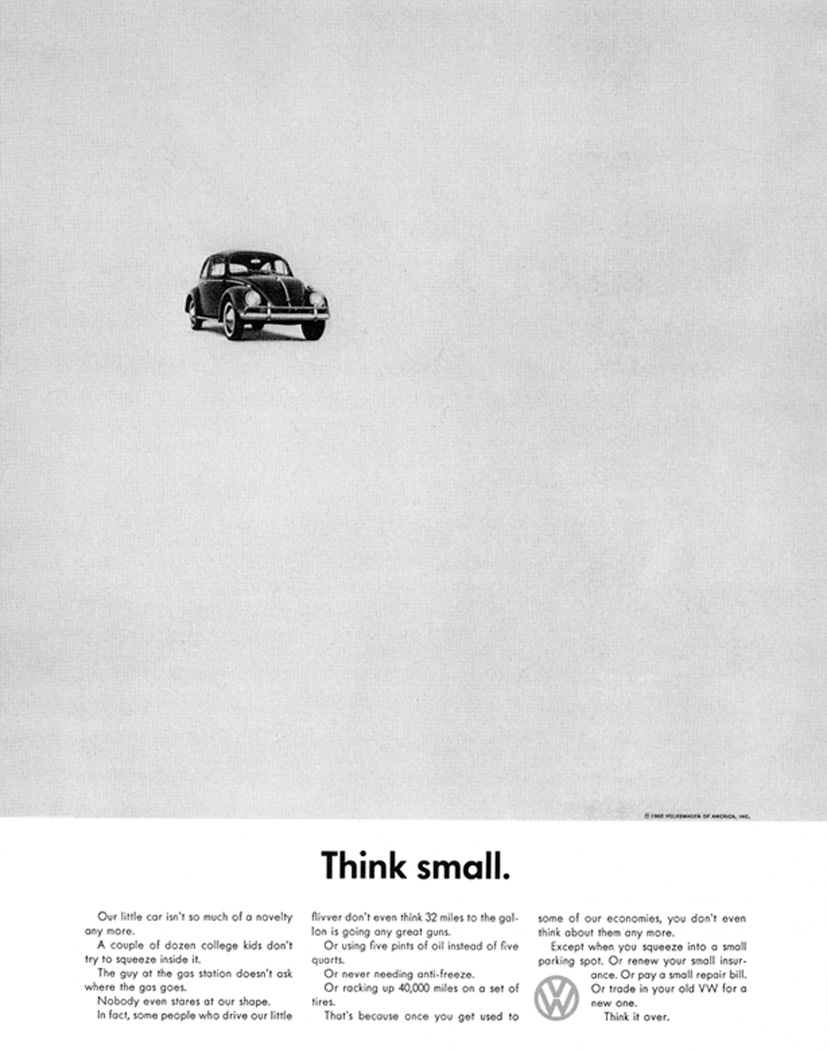
The copy reads:
Our little car isn't so much of a novelty any more. A couple of dozen college kids don't try to squeeze inside it.
The guy at the gas station doesn't ask where the gas goes.
Nobody even stares at our shape
In fact, some people who drive our little flivver don't even think 32 miles to the gallon is going any great guns.
Or using five pints of oil instead of five quarts..
Or never needing anti-freeze.
Or racking up 40,000 miles on a set of tires.
That's because once you get used to some of our economies, you don't even think about it any more.
Except when you squeeze into a small parking spot. Or renew your small insurance. Or pay a small repair bill. Or trade in your old VW for a new one.
Think it over.
It was revolutionary. And, though the art of the press copywriter is now near dead, it can still teach much to those who now write on-line content.
Monday, 21 September 2009
Friday, 18 September 2009
The Found Art Gallery II
Following the outstanding critical success of my first Found Art Exhibition, nearly a year ago, I launch my second of more Objects Trouvés Avec Ma Caméra du Téléphone Mobilé - sounds so much more impressive en français, non?
(Click on images to enlarge.)
Monday, 14 September 2009
Bugs and Other Gripes
I am envious of doers. My friends living in Brittany are doers. They have to be; they are permaculturalists with a small-holding and their animals will not stand for petty upsets in their personal lives. They need feeding - NOW.
There is something wonderful in the rhythms of life, in the seasons, in the-day-to-day necessities of living, in living, no better exemplified than in the naturalist's, Kingsdowner, blog. And this is especially true if, like Stuart and Gabrielle, you are responsible for the lives of others, even if your ambition, is, in the end, to fatten, kill and eat the animals you care for. Apologies to vegans and vegetarians, but that is as has been and so it will be for an age to come.
It is the caring that is all. We all live and die. Who we care for and who cares for us makes our lives. For care read love, read a shift of two letters, read life.
As an intellectual - and I wonder at the shiver that the use of such a word sends up the collective spine of the Western world, unless you happen to live in France - as I say, as an intellectual, as someone who is fascinated by thought, by the ideas that motivate us all whether we like it or not, are aware or not, I find the doing very difficult.
My ambition is great; my ability feeble.
I read the crabbit's blog, Nichola Morgan, who seemingly lives her life in whirl of writing, lecturing, chocolate and pointy shoes; I follow Caroline Smailes blog and her young man, Gary, who has set up what appears to be a very successful, first-aid emergency service to wannabe writers and wonder. I was like them. I used to be a doer.
Now I am less than sure where my arse is from my elbow. I used to be absolutely positive one was the object I sat on, the other I leant on; now, who knows. Such intermindableness breeds the same. I am no longer confident in what I say.
I need to write. Artists of every description, of any talent, are sensitive to the lack of logic of life. It is an inhibition. Yet how can one assert a point of view if one is less than certain any has any value?
Last night, I dug out all the sketches I have made over the last few years and was surprised how some still resonated. They were few but still made a point. Creating is a process that is very hit and miss. I, of course, want to hit. And, I suppose, the culmination of this thought is doing. To do is to do. Only by doing can we fail and thereby learn.
Back to novel two. Novel three, the one I really want to write, needs loads of research.
The image of the bug is for Kingsdowner. It and his/her relatives have recently been invading my and Sue's property and I hope he'll be able to identify it.
Saturday, 12 September 2009
Art Overdose
We went on a cultural weekend, my friend and I. First visit was to Pallant Art Gallery in Chichester. It is not the greatest of spaces with seven galleries being too grand, rooms is better, leading off a central galleria. However, the lighting is sensitive and the content worth the visit.
In the galleria hung the standing exhibition of Modern British Art: The First 100 Years - based on the assumption the art in Britain ended some time around 1977. Work by Peter Blake, Patrick Caulfield, Richard Hamilton, and Eduardo Paolozzi took me back to the days when my hair reached my shoulders.
Examples from four artists under the title of The Scottish Colourists were exhibited in three rooms. It was interesting in that it demonstrated the extent to which landscape influences the palette.
I always associate Scottish Art of the late 19th, early 20th century with tertiary colours, reflecting the heather, moors and peaks of the Highlands. It was notable in several works on show; however, when the artists make their obligatory trip to France, they choose a primary-based palatte, influenced, no doubt, by the Impressionists but also by the fact their usual choice would be totally inappropriate. One painting stood out; washed-out in tone, it was a view of the corner of a white-washed building under the shadow of a tree. It so well expressed the feeling of torpid heat, one could smell the very individual fragrance of over-heated air.
The last exhibition we visited was Outside In, examples of Art Brut or Outsider Art, executed by those historically associated with the fringes of society - prisoners, drug and alcohol abusers, those with mental illness or learning difficulties…
The theme of most of the work was as might be expected - alienation, despair, loneliness - but some art transcended those bonds and was truly outstanding.
The following day we went to the Church of All Saints, Tudely, near Tonbridge in Kent; a small jewel box of a church blessed with stained glass windows by Marc Chagall. My companion has blogged on the history behind the commission, I shall just offer you these images:

You can see what I mean by the jewel box effect. The church is simply painted in white with no other decoration to clash with the windows.
In the galleria hung the standing exhibition of Modern British Art: The First 100 Years - based on the assumption the art in Britain ended some time around 1977. Work by Peter Blake, Patrick Caulfield, Richard Hamilton, and Eduardo Paolozzi took me back to the days when my hair reached my shoulders.
Examples from four artists under the title of The Scottish Colourists were exhibited in three rooms. It was interesting in that it demonstrated the extent to which landscape influences the palette.
I always associate Scottish Art of the late 19th, early 20th century with tertiary colours, reflecting the heather, moors and peaks of the Highlands. It was notable in several works on show; however, when the artists make their obligatory trip to France, they choose a primary-based palatte, influenced, no doubt, by the Impressionists but also by the fact their usual choice would be totally inappropriate. One painting stood out; washed-out in tone, it was a view of the corner of a white-washed building under the shadow of a tree. It so well expressed the feeling of torpid heat, one could smell the very individual fragrance of over-heated air.
The last exhibition we visited was Outside In, examples of Art Brut or Outsider Art, executed by those historically associated with the fringes of society - prisoners, drug and alcohol abusers, those with mental illness or learning difficulties…
The theme of most of the work was as might be expected - alienation, despair, loneliness - but some art transcended those bonds and was truly outstanding.
The following day we went to the Church of All Saints, Tudely, near Tonbridge in Kent; a small jewel box of a church blessed with stained glass windows by Marc Chagall. My companion has blogged on the history behind the commission, I shall just offer you these images:

You can see what I mean by the jewel box effect. The church is simply painted in white with no other decoration to clash with the windows.All the windows are predominately blue, reflecting, perhaps, the drowning of Sarah d'Avigdor-Goldsmid for whom the windows were commissioned as a lasting memorial. The only two windows that are immediately optimistic in colour values stand either side of the entrance.

Sunday, 6 September 2009
Cult of the Done
- There are three states of being. Not knowing, action and completion.
- Accept that everything is a draft. It helps to get it done.
- There is no editing stage.
- Pretending you know what you're doing is almost the same as knowing what you are doing, so just accept that you know what you're doing even if you don't and do it.
- Banish procrastination. If you wait more than a week to get an idea done, abandon it.
- The point of being done is not to finish but to get other things done.
- Once you're done you can throw it away.
- Laugh at perfection. It's boring and keeps you from being done.
- People without dirty hands are wrong. Doing something makes you right.
- Failure counts as done. So do mistakes.
- Destruction is a variant of done.
- If you have an idea and publish it on the internet, that counts as a ghost of done.
- Done is the engine of more.
I found this manifesto via a tweet from which these images come, respectively by James Provost and Joshua Rothaas . True it sounds like the commandments for a dubious religious group and the language is a little clunky; then it was executed in twenty minutes. That said, I do like some of the embedded thoughts.
It is in the doing that things get done: in the writing that books get writ. And though we are exhorted at every turn by every agent and publisher not to submit until it is perfect, it is necessary to understand what is meant by that.
There is no such thing as perfection. If there were all that could be done would have all been done years ago, and human beings would be sitting peacefully together making daisy chains. Indeed, there would be nothing for us writers to write about because that is what we constantly write about – the imperfection of man and woman.
What agents and publishers want is prose that is perfect as possible in its structure, grammar, and punctuation; plot, theme and expression. Not the perfect novel, as if there was such etched in iron, monitored by the Bureau International des Poids et Mesures and stored, alongside the standard metre, in Sèvres. However, they do want your fingerprints all over the novel; your idyosyncratic eye, your quirky descriptions, your individual perspective. There will only ever be one Dostoyevsky, one Hemingway, one Flaubert, one King… name your favourite author, just as there will only ever be one you.
Pretending you know what your are doing is almost the same as knowing what you are doing…
It is a truism to say mankind is constantly trying make sense of the world around, to impose form on the shapeless, find logic in the illogical, and I believe this to be more true of writers than anyone else (apart from politicians but who would want to be a politician?). So I like the reverse of this thought: when you are floundering, out of your depth and panicing, relax – this is reality. You, as writer, live in an unreal world of dreams where you impose your order on chaos through the power of your imagination. You have just woken up for a moment. Have a bath. Pour yourself a glass of wine. In due course your dreams will take a different shape and, suddenly, all will make sense again.
If it doesn’t, Failure Counts as Done. As Do Mistakes.
This I like even more. It is the fear of failure that most inhibits the writer. So many new writers produce manuscripts that are, in marketing parlance, me too books, i.e. works that are so similar to the mainstream of the genre there is no reason why anyone should pick them up to read.
Producing a book that dares to wave a page over the parapet of books lining the shelf, and shout ‘Yahoo! Read me I’m different” is risky. It may fail. However, if it does you will learn.
Did you write a book that was different for the sake of being different. In other words, something that is contrived and awkward. Not a good idea. Difference that is valid comes about through a unique insight or perspective; a point of view that is true to itself and not imposed.
We all know how difficult it is to write, Stephen Fry elegantly elaborates this very point in his latest post, so the dread that, after all the pain, the object produced is unreadable is a serverly restricting bridle. However, if you submit tamely, you will never discover what it is like to run free.
Saturday, 29 August 2009
Blogs We Would Like to Read
Imagine, and I will pick my heros, Descartes, Shakespeare, Chaucer, Jean-Paul Sartre, Maurice Merleau-Ponty, Simone de Beauvoir, Emily Bronte and sisters, Graham Greene, Evelyn Waugh, the list goes on, what would they be blogging today?
Here are my thoughts for some topics - I am sure there are better:
Descartes: Blogito ergo sum
J-P Sartre: Other people's posts are hell.
Emily Brontë: Heathcliff! You don't e-mail, you don't twitter, you don't post. It's been twenty years and still I haven't heard from you.
Greene: I must confess I wonder if it is sinful to share my thoughts with you.
Waugh: So vulgar!
Wednesday, 26 August 2009
Writing Don't Make a Writer
Isn't it interesting the extent to which the blindingly obvious is stated as the brand new. Perhaps it's one's age but so much of what I read is equivalent to the instruction not to light up a cigarette in a petrol station.
So let's blind you with the obvious.
If you are a wannabe writer, if you have dabbled, if your mum loves your school essays, if all your friends tell you to set your stories down, do it.
It is a start. The start. But only a start.
Execute what you write in short, sharp sentences. Forget flowery descriptions, over-puffed analogies, excessive psychological motivations: stick with what happens. It will make you feel uncomfortable, as though you are truncating your talent. You are not. Your talent is not to establish a new set of clichés but to tell an unique story.
Strip all description. Allow the characters to speak for themselves without you interceding on their behalves and interpreting how the reader should understand what you mean them to say.
If he/she is irate, what they say should effect their irritation, not the adverb qualifying the mode of their speech.
"Fuck off" needs no qualifiers; less crude language, suitably crafted, allows the reader to understand how to read the mood of the protagonist.
On that topic, do not, more emphatically, DO NOT, attempt to control the interpretation of the reader. You have no control. To my mind, that is the joy of writing; you never know how the words you have set on paper will affect others; their imaginations, with your prompting, will escape into the night air to dance with moths.
Start simple, stay simple, pretend not to be a writer, i.e. someone you regard as a writer; be as true and honest to yourself and your characters as you can; worry about improving your words as experience teaches you; because you can string words together on a page does not make you a writer or author - years, and I mean years, of work take that. I know, I have written professionally for forty years and am just beginning to feel comfortable.
Subscribe to:
Posts (Atom)


